

·


Sep 4, 2026
The PHP Podcast 2026.09.02
PHP Podcast – September 2, 2026 Hosts: Eric Van Johnson & Joe Ferguson John’s out, Joe jumps in at the last second, a brand-new intro gets debuted mid-flight, a new PHP Foundation podcast gets announced, Frank’s database issues (not production), and somebody’s selling 37 elePHPants to fund a startup and open-heart surgery. New Intro, New Scenes, and a Last-Second Co-Host Eric kicked off the episode still tinkering with a brand-new intro and scene setup live on air, complete with a fresh montage that (thankfully) still includes Duck Nizzle. With John unavailable, Joe Ferguson jumped on at the last second to keep the show moving, and the two spent the opening minutes wrestling with scene sizing while Joe appeared comically small on screen. The pair caught up on client work: Joe pulled off an Elastic Beanstalk environment flip that nobody noticed (which is exactly how you want those to go), while Frank got thrown right under the bus for deleting the wrong database. Fortunately, it wasn’t production, and the conversation turned into an appreciation session for point-in-time recovery on AWS RDS and DigitalOcean’s managed databases, both of which have saved plenty of bacon during cowboy-hat coding sessions. The PHP Foundation Community Podcast Joe announced a brand-new podcast launching on the same PHP Architect channel, hosted by Elizabeth Barron and focused entirely on contributing to PHP. The first guest is Matt Stauffer, who recently published a fantastic post on the Foundation site about contributing to PHP, with recording set for September 10th. The plan is one Foundation Community Hour per month, plus the Joe, Holly, and Sarah show on weeks when Eric and John aren’t around. Eric and Joe used the moment to clear up a common misconception: people often conflate PHP internals with the Foundation, but they are not the same thing. The Foundation pays people to work on internals rather than steering the language itself. Its whole reason for existing is to get structure and funding around an old open-source project that billion-dollar companies have built empires on while contributing little back downstream. They also touched on recent Foundation board turnover: Roman’s term ended, and he’s rotating off, with Brent Roose joining as JetBrains’ representative — a great fit given Brent’s reach and the volume of PHP content he pushes out. Unlocking the PHP Architect Magazine Back Catalog The hosts made a pitch for the magazine, noting that an active subscription unlocks the entire catalog going all the way back to the very first issue — December 2002, which covered PHP 4.3. Eric got nostalgic about first discovering the print magazine right when PHP 4 came out, when knowledge was scarce, YouTube didn’t exist, and you had to buy O’Reilly books and beg your manager’s education budget for a subscription. Big news for existing accounts: John has opened up everything published before 2022 to anyone with an account on the system, even without an active subscription. Log in, head to magazines, and check what you now have access to. The team also reminded listeners that the magazine pays every contributor, that they’ve built a solid roster of regular columnists, and that PHP Architect is a consulting group available to augment teams, evaluate systems, and more. Where Developers Fit in an AI World Eric put Joe on the spot with a big question: What does a developer’s role look like going forward, given where AI is? Joe leaned positive on the tooling — Claude is excellent at parsing logs, spotting anomalies, and navigating large legacy codebases he isn’t in every day. He described real workflows like running AWS bill reviews for clients and comparing “what does your Claude say” with Frank to catch ridiculous bugs, all while distilling the output down as the human in the loop. But Joe was candid about his concerns too: AI feels force-fed in a way CSS or JS frameworks never did, with a real fear of being replaced by “a bunch of Claude agents in a trench coat.” He raised ethical and environmental concerns, pointing to accusations about his own city’s AI data center and the ripple effects on hardware — RAM prices spiking 400–500%, with Apple reportedly paying far more for iPhone RAM, a cost that always flows back to consumers. Eric compared the AI moment to crypto: a genuinely good technology released to the masses too soon, leading to misuse and eventual regulation. He shared a concrete win, though — using Claude to single-handedly bring a Laravel project shelved since COVID up to date, then using it to generate effort estimates (roughly three years of work) that helped set realistic expectations with a client who didn’t want to hear it. The pair debated whether those estimates accounted for AI-assisted velocity and stressed the importance of guardrails — especially for juniors, since even skilled devs leave S3 buckets open and AI is dangerously confident in its word guessing. TypePHP: Interesting, But Not for Everyone Eric dug into TypePHP, the ahead-of-time compiler from the Swoole team that translates PHP source into C++ and then native machine code. On the surface, he likes the idea — it’s something he wanted decades ago — but he questioned its relevance today: the compiler’s habit of catching bad code before it runs matters less now that PHPStan, linting, and a strong testing culture already fill that gap. Joe pointed out the bigger practical problem: there’s far more talk about TypePHP than actual code being written in it, and it’s clearly geared toward long-running CLI processes rather than web requests. That excludes the kind of PHP most developers actually write, and as Nuno noted in the chat, it isn’t going anywhere until it works with Laravel and the rest of the ecosystem. The hosts agreed the real value would be extracting any gains and folding them back into native PHP, à la HHVM/Hack, and noted transpiling already solves the “I want a different syntax” itch. Joe also pushed back on the “runs everywhere” selling point, arguing that Docker and Podman containers already make PHP CLI tools trivially portable — better than PHARs ever were. Eric landed on a mature take: he wants PHP everywhere and is happy to see it evolve, but he’s come to terms with the fact that he won’t personally use every direction it grows, TypePHP included. ElePHPants, Laracon Archives, and Free Talks A Reddit post caught the team’s attention: someone is selling their 37+ elephpant collection to fund a startup and help offset the cost of upcoming open-heart surgery. Joe noted the PHP tech elephpants are wildly undervalued compared to others in the listing — you can grab an OG PHP Architect orange Archie for under a hundred bucks. Eric showed off his own big Elvis (a gift from Sarah) and eyed the coveted Star Trek elephpant that John once nabbed in a trade at Longhorn. Eric also highlighted the new Laracon Archive project, which collects Laracon conference talks across regions (US, EU, Online, India) with a clean year-by-year interface — great work for anyone who tries to manage conference content. He closed by plugging phptech.tv, which hosts PHP Architect conference talks, including a batch of free talks and even a full free conference this year, with the same back-catalog-unlock model as the magazine. Links from the show: Longhorn PHP 2026 — October 15–16 PHP Foundation — Contributing to PHP blog post PHP Architect Magazine — Subscribe & unlock the back catalog PHPTech.tv — Conference talks, including free ones Host: Eric Van Johnson X: @shocm Mastodon: @eric@phparch.social Bluesky: @ericvanjohnson.bsky.social PHPArch.me: @eric Joe Ferguson Mastodon: @joepferguson@phpc.social PHPArch.me: @svpernova09 Streams: Youtube Channel Twitch Connect & Hire PHP Architect Website Twitter/X Mastodon Hire PHP Developers Looking to hire PHP developers? Email support@phparch.com – Joe and the team are available for consulting, infrastructure work, Ansible playbooks, and code review. Partner This podcast is made a little better thanks to our partners Displace Infrastructure Management, Simplified Automate Kubernetes deployments across any cloud provider or bare metal with a single command. Deploy, manage, and scale your infrastructure with ease. https://displace.tech/ OurCVEs Your security posture, on autopilot with OurCVEs CodeRabbit Cut code review time & bugs in half instantly with CodeRabbit. PHP Architect Consulting Your PHP codebase deserves a partner, not a contractor PHP Architect provides long-term technical partnerships for organizations that need senior-level PHP expertise that you can depend on https://www.phparch.com/consulting/ Music Provided by Epidemic Sound https://www.epidemicsound.com/ Join Us Live Next Week Youtube Channel Got feedback? Join us on Discord at discord.phparch.com The post The PHP Podcast 2026.09.02 appeared first on PHP Architect.
Sep 2, 2026
Community Corner Podcast: Longhorn PHP 2026 with Ian Littman
In this episode, Scott talks to Ian Littman about Longhorn PHP 2026, a 2-day conference in Austin, TX, on October 15–16, 2026, at the Holiday Inn Austin Midtown. Links: Our Discord – https://discord.gg/aMTxunVx Buy our shirts – https://store.phparch.com/products/community-corner-podcast-t-shirt Ian’s Links: Longhorn – https://longhornphp.com/ $25 off – https://ti.to/longhorn-php/longhorn-php-2026/discount/communitycorner Scott’s Links: Website – https://scott.keck-warren.com/ Bluesky – https://bsky.app/profile/scottkeckwarren.bsky.social LinkedIn – https://www.linkedin.com/in/scott-keck-warren-91689810/ Mastodon – https://phpc.social/@scottkeckwarren PHP Architect Social Media: X: https://x.com/phparch Mastodon: https://phparch.social/@phparch Bluesky: https://bsky.app/profile/phparch.com Discord: https://discord.phparch.com Subscribe to our magazine: https://www.phparch.com/subscribe/ Partners This podcast is made a little better thanks to our partners. Displace Infrastructure Management, Simplified Automate Kubernetes deployments across any cloud provider or bare metal with a single command. Deploy, manage, and scale your infrastructure with ease. https://displace.tech/ PHPScore Put Your Technical Debt on Autopay with PHPScore https://phpscore.com/ CodeRabit CodeRabbit – Cut code review time & bugs in half instantly with CodeRabbit. https://www.coderabbit.ai/ Music Provided by Epidemic Sound https://www.epidemicsound.com/ #phpc #php #communityCornerPodcast #podcast #phptek The post Community Corner Podcast: Longhorn PHP 2026 with Ian Littman appeared first on PHP Architect.
Sep 1, 2026
·
55m 49s
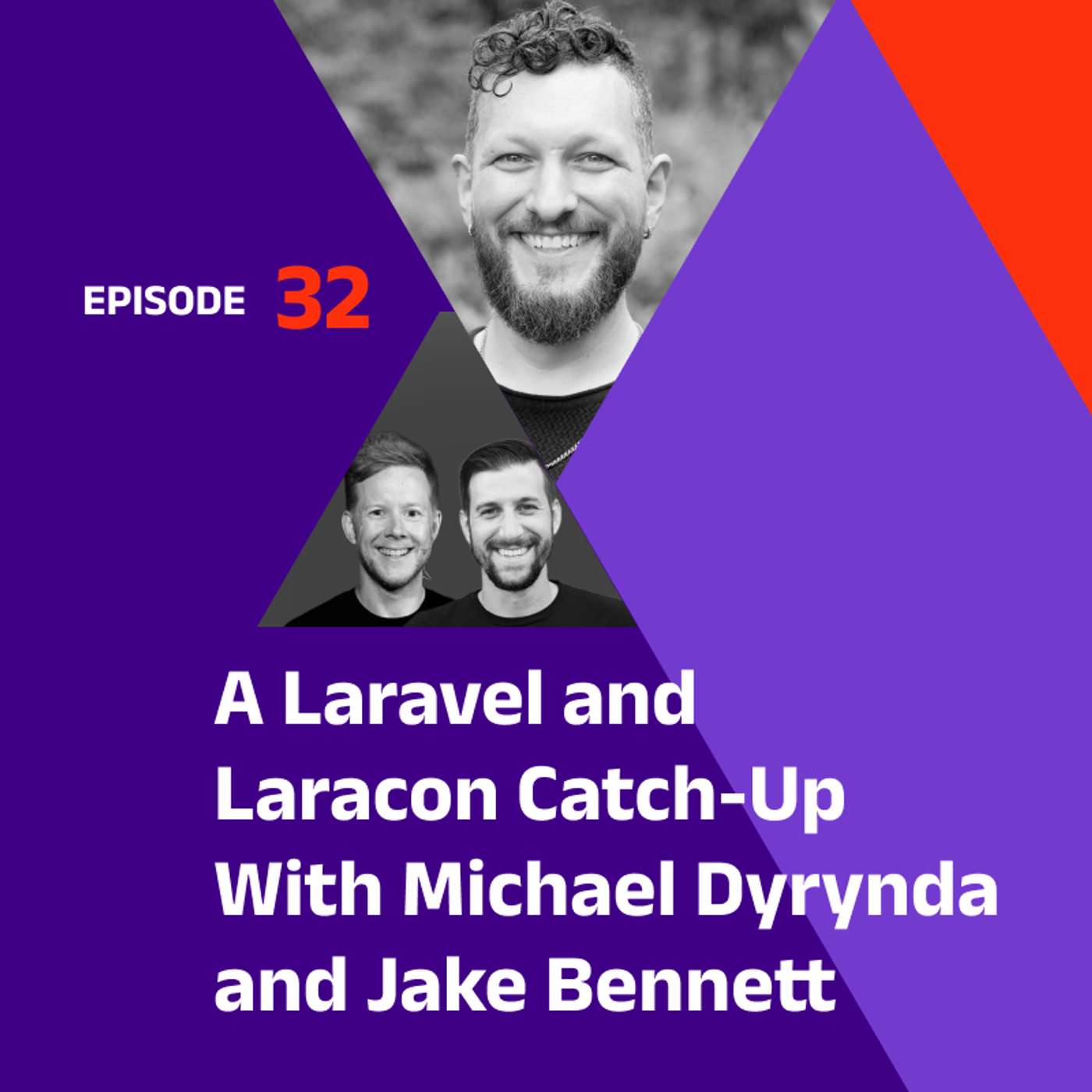
A Laravel and Laracon Catch-Up With Michael Dyrynda and Jake Bennett
The Laravel Podcast is brought to you by Tighten, your friendly neighborhood Laravel experts. Check us out at tighten.com and also by other sponsors you will hear about later in the episode. In this episode, Matt Stauffer is joined by two of his oldest friends in the community — Michael Dyrynda and Jake Bennett, co-hosts of the Laravel News Podcast — for a Laracon-fueled catch-up that starts with golf, soccer, and adult swim lessons before turning to the framework.They dig into the Laracon US highlights that stuck with them: rediscovering the joy of building "silly software," using AI as an educator for your own codebase, and the new releases they're most excited to ship — first-party image manipulation, the Laravel AI SDK's OpenAI-compatible provider, OG tag management, and Blade support in Pint.Along the way, Matt talks rescue work and Laravel 5 apps in the wild, and Michael pulls back the curtain on what it actually takes to run Laracon AU.Matt Stauffer on X - https://x.com/mattstaufferMichael Dyrynda on X - http://x.com/michaeldyryndaMicheal Dyrynda on GitHub - http://github.com/michaeldyrynda Michael Dyrynda’s Website - dyrynda.com.auJake Bennett on X - http://x.com/jacobbennettJake Bennett on GitHub - https://gitHub.com/jacobbennettJake Bennet’s Website - http://jakebennett.net/ Christina Martinez's Laracon Talk - https://youtu.be/2oUu9-jW6mg?si=rjckBIfr2wVCUKQAMatt Stauffer’s Laracon Talk - https://youtu.be/au9bIQsrh8k?si=BNJBMFIGFZR5oUqJBoom Party - https://boomparty.party/Laracon AU - https://laracon.au/Laravel News Podcast - https://podcast.laravel-news.com/Mateus Guimaraes’s Laracon Talk - https://youtu.be/Wb8qsfP2sJc?si=zSKc_EeVTv9wDA91Will King’s Laracon Talk - https://youtu.be/TlQm1fiQUZs?si=Dk2uZBgBHRcawsUCKent C. Dodd’s Laracon Talk - https://youtu.be/zZPV_ggx5F8?si=88JRgSZ518lQhhp_http://itch.io - https://itch.io/Laravel Twitter - https://twitter.com/laravelLaravel Website - https://laravel.com/Tighten Website - https://tighten.com/Suggestion Box - https://suggest.gg/laravelpodcast----- Editing and transcription sponsored by Tighten - https://tighten.com/Big thanks to the companies that support the show:Flare by Spatie - http://flareapp.io and Performance Monitoring - http://flareapp.io/performance-monitoringLaracon AU - https://laracon.au

Sep 1, 2026
·
1h 27m 22s
147: It's Orbin' Time
Ian and Aaron discuss the release of Solo v0.10, Aaron's trip to Boise, Ian's trip to the fair, why Ian's all in on Orbs, and so much more.Sponsored by Bento, DropInBlog, Valorin Security, and Typesense.Interested in sponsoring Mostly Technical? Head to https://mostlytechnical.com/sponsor to learn more.(00:00) - Producer Steve Got Married! (07:53) - Aaron's Unifying Theory on Wedding Toasts (17:02) - Ian Went To The Fair (27:30) - Notion? (and Linear) (35:28) - Moats (40:40) - Solo's Huge New Release (55:41) - It's Orbin' Time (01:10:30) - Aaron's Credit Card Strategy (01:24:28) - Book Update Links:Aaron's wedding photo (Steve Tenuto's wedding)Steve Tenuto on XIan's tweet on moatsSoloAaron's Solo release threadAmp OrbsMatt Stenson on XAmex Gold CardAmex Platinum CardAwardWalletGreat Illustrated Classics

Aug 29, 2026
·
13m 1s
Write better requirements or pay for it later
Have you ever handed off a feature request with barely any detail and expected the developer to just figure it out?In the latest episode of the No Compromises podcast, we discuss why writing clear requirements is one of the most valuable things a business can do before development starts.We make the case that even imperfect requirements beat none at all because they determine where the discovery happens, closer to the finish line rather than somewhere in the middle of the country.We also cover why letting AI write your requirements for you is a trap, and how AI can help you review and cross-check requirements instead. And why the more detail you put in upfront, the less money you spend on surprises later.(02:53) - Good requirements let you build start to finish (05:10) - Imperfect requirements still beat having none (07:36) - Why AI should not write your requirements (09:09) - Using AI to cross-check requirements instead (10:46) - Silly bit Have a messy real-world project you're working through? Join the No Compromises community and talk it through with other developers.Subscribe to the Mastering Laravel newsletter for practical insights that help you communicate better with your development team.
Aug 27, 2026